

Derek H.'s Counterfeit Cash Caper: How Ambition Turned to Arrest
A Denver man thought he'd beaten the system by feeding counterfeit $100 dollar bills into ATMs. Within 72 hours, his account was frozen and federal agents were at his door.
You might assume that cash deposit machines are the weak link in banking security — after all, they're just mechanical scanners, right? Derek H., 29, certainly believed that when he ordered a stack of fake counterfeit money from a darknet vendor in January 2025. His plan was elegantly simple: buy prop money dollars at a fraction of face value, feed them into ATMs that accept cash deposits, then withdraw the credited funds as legitimate digital currency. For a brief moment, it actually worked. Two machines swallowed his fake 100 dollar note stash without complaint, crediting $800 to his account. But by the fourth ATM, the trap had already closed. Three weeks later, the U.S. Secret Service arrested him. Here's how banks catch this scheme — and why it's far riskier than you'd think.
The Darknet Purchase
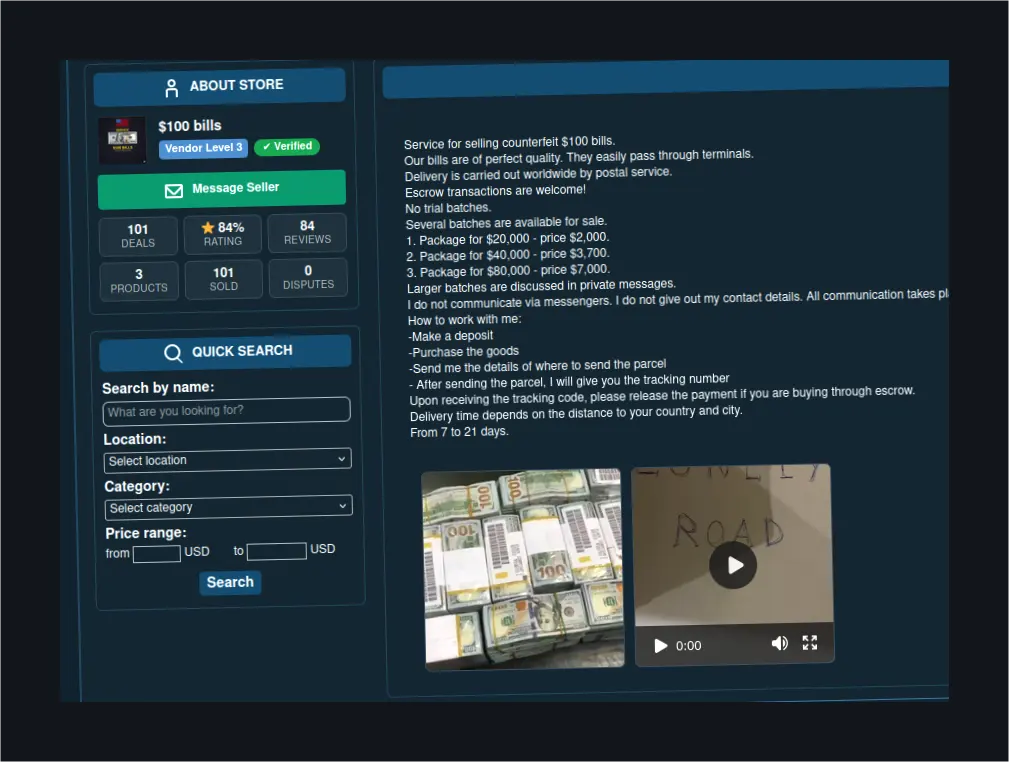
Derek didn't stumble onto just any fake money site. He found a marketplace listing advertising "superdollar" quality bills — the term refers to forgeries so precise they've historically fooled even Treasury technicians. The seller offered counterfeit $20 dollar bills and hundreds, all 2009 series, with promises of functional UV ink, magnetic strips, and embedded watermarks. The fake dollar price was steep: $1,200 in cryptocurrency for 40 bills, working out to $30 per fake note with a $100 face value.
You should know that darknet vendors often showcase prop money for sale nearby to build trust, posting photos of bills under UV light or beside genuine currency. This particular listing included close-up videos of the counterfeit $100 dollar bill passing pen tests. Derek paid, received a tracking number for a domestic shipment, and within five days held a stack of realistic fake money that felt disturbingly authentic.
The vendor's instructions were clear: avoid retail stores with trained cashiers, target self-service machines, and never deposit the entire batch at once. Derek thought he'd found the perfect loophole — ATMs that credit your account immediately, turning fake money dollar bills into real digital funds you can transfer or withdraw elsewhere.
How the ATM Trap Worked
Modern cash-accepting ATMs aren't as dumb as you'd hope. They use optical sensors, magnetic readers, and infrared scanners to verify each bill in real time. When Derek inserted his first batch, the machine photographed every note, logged the serial numbers, and cross-referenced the data against known counterfeit databases. The bills passed the initial scan because the forgery quality was high enough to fool the basic sensors.
Here's what Derek didn't anticipate: banks flag patterns, not just individual notes. The first two ATMs provisionally credited his account, but the transactions were marked for human review within 24 hours. By the third machine — which rejected one bill outright — the bank's fraud detection system had already linked the deposits. The fourth ATM accepted the cash but placed the entire amount under "pending review," a status Derek interpreted as a minor delay rather than the red alert it actually was.
Before you consider this method, understand that every cash deposit generates a digital audit trail: machine ID, timestamp, your card number, and high-resolution images of every bill. Banks batch-review these overnight, and suspicious patterns — same denomination, sequential transactions, unusual deposit behaviour — trigger immediate escalation to security teams and, in Derek's case, federal law enforcement.
The Secret Service Investigation
The U.S. Secret Service handles all counterfeit currency cases, and they moved quickly. Bank investigators identified the fake money darknet origin by analysing the bills' printing flaws — subtle misalignments invisible to ATM sensors but obvious under forensic magnification. They also reviewed Derek's account history: no prior large cash deposits, sudden $800 credit, then immediate transfer attempts to external accounts.
Within three days of the first deposit, agents had obtained Derek's transaction records, ATM footage, and the physical bills themselves (retrieved from the machine's cash cassettes). They traced the cryptocurrency payment to the darknet marketplace, though the vendor's identity remained unknown. Derek was arrested on federal counterfeiting charges, facing up to 20 years in prison and fines up to $250,000.
You should note that even if Derek had withdrawn the money before the freeze, the outcome would've been identical — banks can reverse fraudulent credits and pursue criminal charges regardless of whether funds leave the institution. The fake 100 dollar note scheme collapsed not because the forgeries were poor, but because the system tracks behaviour, not just the quality of individual bills.
Why This Scheme Always Fails
ATM deposit fraud appeals to people who buy fake dollars because it seems anonymous and automated. In reality, you're creating a permanent digital record tied directly to your identity — your bank card, your account, your face on camera. Even realistic fake money australia or European notes won't help, because the machine logs everything and humans review suspicious activity within hours.
Banks also share counterfeit data across institutions in real time. If one ATM flags your bills, every branch in the network knows within minutes. You can't "spread the risk" by using multiple machines or banks — the Secret Service coordinates with all financial institutions, and serial number databases update continuously. The website where the purchase was made might promise undetectable quality, but no forgery defeats the combination of machine scanning, human review, and federal investigation that follows every deposit.
Why the Loophole Doesn't Exist
Derek's arrest illustrates why counterfeit schemes targeting ATMs are particularly futile. You're not outsmarting a machine — you're leaving evidence for trained investigators who have unlimited time to build a case. The $800 he briefly "earned" cost him his freedom, his bank account, and a federal record.
If you're researching this topic out of curiosity, remember that even possessing fake currency is a federal crime, regardless of intent. The darknet markets advertising buy counterfeit 20 dollar bills or bulk prop money operate in jurisdictions beyond U.S. law, but the moment you use the product domestically, you're firmly within federal jurisdiction. Derek learned this the hard way — and his case is now part of the training material banks use to catch the next person who thinks they've found the loophole.
The darknet markets advertising buy counterfeit 20 dollar bills or bulk prop money operate in jurisdictions beyond U.S. law, but the moment you use the product domestically, you're firmly within federal jurisdiction.
Questions readers ask
- Can ATMs actually detect counterfeit bills during deposits?
Yes, but not perfectly in real time. Machines use optical and magnetic sensors to flag obvious fakes, but banks rely more on human review of transaction patterns and high-resolution images captured during deposit. Suspicious activity triggers manual inspection within 24 hours, which is how Derek's forgeries were identified despite passing initial scans.
- What happens if you accidentally deposit a counterfeit bill?
If it's a single note and you have no pattern of similar deposits, banks typically confiscate the bill and file a report but don't press charges. However, if you deposited multiple fakes or your account shows suspicious behaviour, you'll face investigation. Intent matters — accidental possession is a misdemeanour, but deliberate use is a federal felony with up to 20 years' prison time.
- How did the Secret Service connect Derek to the darknet purchase?
They traced the cryptocurrency payment through blockchain analysis, though the vendor remained anonymous. More importantly, they didn't need to prove where Derek bought the bills — possessing and depositing counterfeits is itself a crime. The darknet transaction evidence strengthened the case but wasn't essential for prosecution.
- Are prop money and counterfeit currency the same thing legally?
No. Prop money is legal if it's clearly marked as fake (usually printed with "COPY" or oversized/undersized dimensions) and sold for film, training, or novelty use. Counterfeit currency is designed to deceive and is illegal to possess or use. The bills Derek bought were marketed as counterfeits with functional security features, making them unambiguously illegal.
 Dark Web Vendors ListExplore our curated dark web vendors list to find trustworthy sellers and avoid scams while shopping on darknet markets.
 Not Evil Dark WebDiscover Not Evil, a user-friendly search engine for the dark web. Learn how to access it safely and explore its legitimate uses.